The call for proposals for the action “Support for investment plans of existing SMEs implemented in the mainland areas of TJTP, in accordance with Regulation (EU) 2021/1056 establishing the Just Transition Fund” – Phase C, and the approval of this call and its annexes, has been announced. The Action will be funded by resources from Greece and the European Union (Just Transition Fund) and will be integrated into the “Just Development Transition” Program 2021-2027.
This action aims to support investment plans to be implemented in the areas of the Territorial Just Transition Plans (TJTPs) of Western Macedonia and Megalopolis, in order to address the social, labor, economic, and environmental impacts of decarbonization and to support their transition to a climate-neutral economy and balanced, sustainable development.
Note for investments in the tourism sector:
Investment plans with an eligible NACE code for tourism sector investments (NACE 55X) must meet the following conditions:
➢ Hotels
- Classification of three stars (3***) and above
- Capacity of eight (8) beds and above
➢ Tourist accommodation in architectural heritage buildings, as provided for in Law 4531/2018 (Article 39)
➢ Organized tourist campsites (camping)
- Classification of three stars (3***) and above
NON-MAIN HOTEL ACCOMMODATION
➢ Self-catering accommodation – furnished tourist residences
- Minimum number of residences: Three (3)
Note: All self-catering accommodation – furnished tourist residences must be incorporated into the same Operating License (Notification).
➢ Furnished rooms – apartments for rent
- Classification of three (3) keys and above
- Minimum capacity of ten (10) beds
Beneficiaries of the action are existing SMEs, as defined in Annex I of Regulation (EU) 651/2014, who will implement an investment plan related to at least one of the eligible activities included in ANNEX XVIII "ELIGIBLE ACTIVITIES (NACE codes).
Existing refers to businesses that have commenced operations and, prior to the date of issuance of the Call, have completed at least one (1) full fiscal year, meaning they have registered their commencement of operations with the competent Tax Office before 01/01/2025.
A completed full fiscal year refers to a period of at least twelve (12) months, for which the final financial result has been determined for accounting purposes and the appropriate tax forms (e.g., forms E3 & N) have been submitted to the Independent Authority for Public Revenue (AADE).
The basic conditions for participation of potential beneficiaries, among others, are the following:
- The potential beneficiary operates or will operate in Greek territory.
- The investment will be carried out exclusively within one area (spatial unit) of the Territorial Just Transition Plans (TJTPs) of Western Macedonia and Megalopolis as specified in the table below:
|
TERRITORIAL JUST TRANSITION PLAN (TJTP) |
SPATIAL UNIT |
|
Western Macedonia |
Regional Units of Kozani and Florina |
|
Regional Units of Kastoria and Grevena |
|
|
Megalopolis |
Municipality of Megalopolis |
|
Municipalities of Tripoli, Gortynia, and Oichalia |
- Does the beneficiary have at least one (1) full completed fiscal year as defined in the call, for which the final financial result has been determined for accounting purposes and the appropriate tax forms (E3 & N forms) have been submitted and cleared with AADE? Does the business qualify as an SME according to Annex – DEFINITION OF SME with the Commission Recommendation 2003/361/EC of 6 May 2003, taking into account the conditions for maintaining this status? Has the potential beneficiary submitted one and only one funding application (one application per Tax Identification Number)?
- The potential beneficiary is not an undertaking in difficulty, according to Regulation (EU) 651/2014 (Article 2, Para. 18 "Definitions").
- The proposed investment plan concerns one or more of the eligible NACE codes included in Annex XVIII: ELIGIBLE ACTIVITIES (NACE codes) of the call, in which the potential beneficiary operates or commits to operate by the submission of the first request for payment of the grant (including the advance payment).
- The proposed investment plan meets the incentive effect condition and, therefore, work on the investment plan has not started before the submission of the funding application, as defined in paragraph 2 of Article 6 of Regulation (EU) 651/2014.
- The proposed investment plan constitutes an initial investment, as defined in Article 2, paragraph 49, point (a) of Regulation (EU) 651/2014, and specifically concerns an investment in tangible and intangible assets related to one or more of the following:
- Creation of a new establishment
- Expansion of the production capacity of an existing establishment. The additional
production capacity of the establishment as a result of the investment plan can
only be accepted if the existing capacity of the establishment before the
implementation of the investment can be certified by official documentation.
iii. Diversification of the output of an existing establishment into products or services not previously produced by the establishment. As regards aid granted to large enterprises or SMEs for the diversification of an existing business establishment, the eligible costs must exceed by at least 200% the book value of the assets being reused, as recorded in the fiscal year preceding the start of works.
- fundamental change in the overall production process of the products or in the overall provision of services covered by the investment in the establishment.
- The financial contribution of the aid beneficiary for the costs subsidized under Article 14 of Regulation (EU) 651/2014 amounts to at least 25% through own resources or through external financing and in a form that does not contain elements of state aid.
- The proposed investment plan is financially viable and specifically:
- the financial contribution of the aid beneficiary amounts to at least 25% of the
total eligible expenses, either through own resources or through external
financing, and the potential beneficiary has submitted the relevant supporting
documents,
- the potential beneficiary demonstrates solvency and submits the relevant
solvency documents,
iii. the potential beneficiary submits a business plan that certifies the future
viability of the investment and is realistic.
- The potential beneficiary has not, in the two years preceding the application for aid, relocated to the business establishment where the initial investment for which aid is sought will be carried out, and commits not to do so within a maximum period of two years after the completion of the initial investment for which aid is sought.
- In the event that the potential beneficiary operates in the fisheries and aquaculture sector, they must not have committed one or more of the infringements referred to in Article 10(1)(a) to (d) and Article 10(3) of Regulation (EU) No 508/2014 of the European Parliament and of the Council.
- The potential beneficiary operates exclusively in one of the following business forms: General Partnership (OE), Limited Partnership (EE), Limited Partnership by Shares (EE KATA METOXES), Limited Liability Company (EPE), Single-Member Limited Liability Company (MONOPROSOPΗ EPE), Société Anonyme (AE), Single-Member Société Anonyme (AE MONOPROSOPΗ), Private Company (IKE), Single-Member Private Company (MONOPROSOPΗ IKE).
- The potential beneficiary keeps Simple-entry or Double-entry books according to Law 4308/2014, as applicable. Companies with a simple-entry accounting system commit to keeping a double-entry accounting system from the start of operations of the investment plan.
- The potential beneficiary operates legally, possessing the appropriate licensing document, in accordance with current legislation and their activity.
- The potential beneficiary has been registered in the Register of Ultimate Beneficial Owners under Article 20 of Law 4557/2018 (A' 139), as applicable.
- The potential beneficiary is not a financial and insurance institution, public enterprise, public body or public organization and/or their subsidiary, Legal Entity of Public Law (NPDD), or a company in which OTAs and all the aforementioned public bodies participate, directly or indirectly, with a percentage greater than twenty-five percent (25%) of the capital or voting rights, individually or jointly (as well as companies assimilated to them, as main partners), sports club, association, sports limited company?
- The potential beneficiary is not an offshore company.
- The amount of the subsidized budget of the investment plan is greater than the minimum limit defined in the Call, and the expenses of the application are linked to the NACE code(s) of the investment plan and the categories of eligible expenses.
- The potential beneficiary complies with the legislation on health and safety of workers and the prevention of occupational risk.
- The potential beneficiary complies with the provisions of the Commission Communication (2021/C 373/01): Technical guidance on strengthening the resilience of infrastructure to climate change during the period 2021-2027.
- There is no outstanding recovery order against the potential beneficiary following a previous decision of the European Commission, by virtue of which aid granted by the same Member State is declared illegal and incompatible with the internal market.
- The potential beneficiary commits that there are no grounds for exclusion under Article 39, paragraphs 1-4 and Article 40 of Law 4488/2017 (A137/13.09.2017).
- The potential beneficiary commits to creating a minimum number of new dependent employment positions (FTEs), which will be additional to those held in the last 12 months before the submission of the funding application, and this increase will be maintained for at least 3 years after the final disbursement of the investment. The minimum obligation is defined as:
– For the creation of a new establishment or expansion of an existing establishment: 1 FTE per €300,000 of grant
– For a fundamental change in the overall production process or in the overall provision of services covered by the investment in the establishment or diversification into products or services not previously produced by the establishment: minimum obligation for employment increase: 1 FTE per €350,000 of grant.
In cases where the investment plan documents two initial investment scenarios with different obligations (e.g., unit expansion and diversification into new products), the minimum obligation is defined as that of the "creation or expansion of establishment" category.
- The potential beneficiary commits that the investment plan is not carried out on the initiative and on behalf of the Public Sector, based on a relevant contract for project execution, concession, or service provision.
- The potential beneficiary commits that the entire investment plan and/or the individual expenses included in this specific funding application:
– Have not been funded under another action funded by national or community resources.
– Do not constitute approved expenses of an investment plan in another action funded by national or community resources.
– If approved, and for the period during which they constitute approved expenses of the investment plan to be implemented, they will not be submitted for inclusion or certification in an investment plan of another action funded by national or community resources.
Exempted from the above requirement/commitment are applications/approvals for funding concerning financial products (loans or guarantees) implemented with national or EU resources, which may additionally fund the same investment plan, provided that the rules on cumulation of state aid and the condition of incentive effect are met.
- The potential beneficiary commits that, until the completion of the investment and depending on the type and nature of the proposed Action, they will ensure appropriate interventions to guarantee access for people with disabilities (PwDs) to building infrastructure, services, and electronic environments, in accordance with the current institutional framework (see Annex XV): "Ensuring accessibility for people with disabilities"). Infrastructure refers to both building infrastructure and electronic applications addressed to the customer public (e.g., websites and other electronic applications, such as electronic information or/and service points, etc.) in accordance with the guidelines of ESAmeA.
- The potential beneficiary commits to implementing the action in a way that ensures:
– respect for fundamental rights and compliance with the Charter of Fundamental Rights of the European Union
– gender equality and gender mainstreaming – prevention of any discrimination based on gender, racial or ethnic origin, religion or belief, disability, age, or sexual orientation
– transparency
– accessibility for people with disabilities
– adherence to the principle of sustainable development and EU environmental policy.
- The potential beneficiary has submitted a funding application electronically to OPSKE, accompanied by all necessary data, supporting documents, and forms.
- All conditions of Chapter I and the applicable articles of Regulation (EU) 651/2014 are met. This criterion will be analyzed into sub-criteria according to the applicable articles for granting aid of the Regulation. EU 651/2014.
- If they have received rescue aid, they must have repaid the loan and the guarantee agreement must have been terminated, or if they have received restructuring aid, it must have been completed. The total score of the funding application is equal to or greater than 65 points.
The above conditions must be met in their entirety. Failure to satisfy at least one or more of them constitutes a condition for exclusion of the investment plan and, consequently, a reason that makes it impossible to submit the application or/and leads to its rejection.
The total Public Expenditure of the Action amounts to €40,000,000.
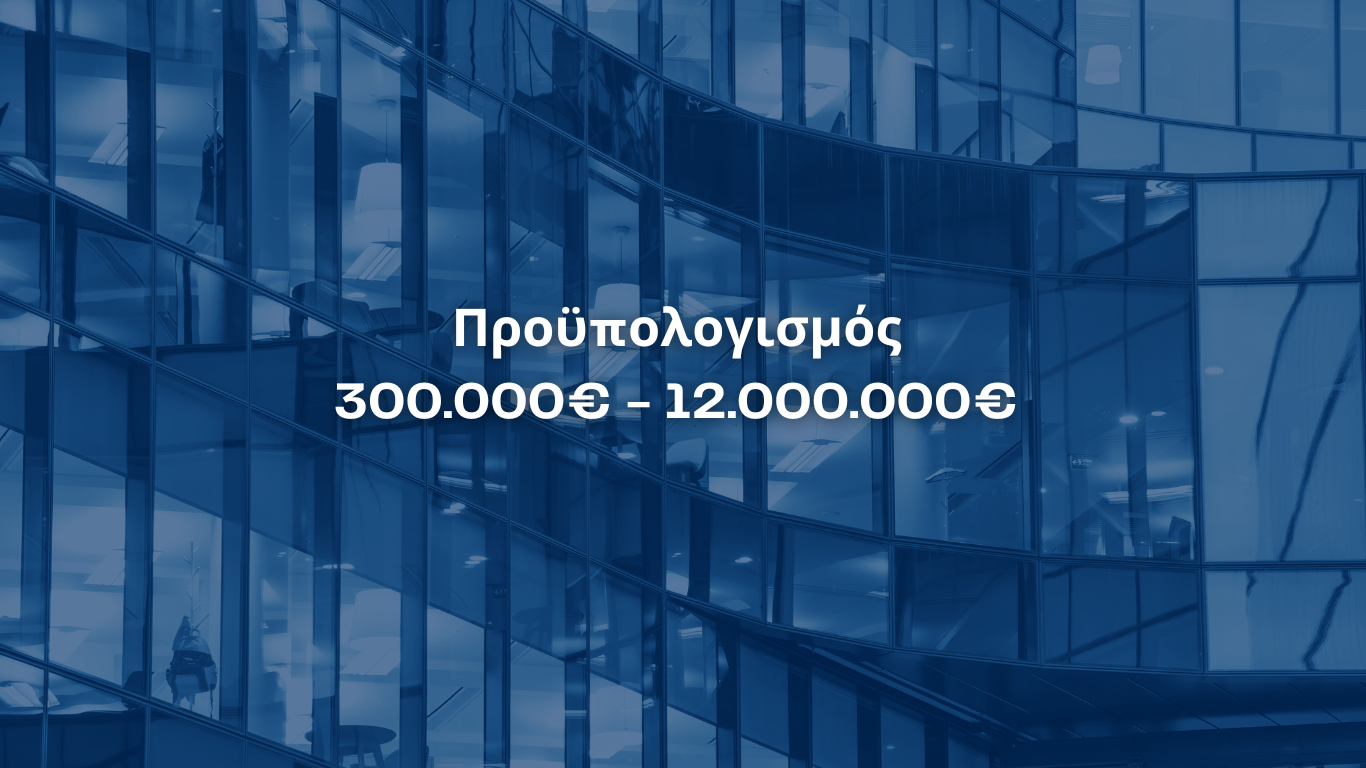
The minimum budget for each investment plan is set at €300,000, while the maximum is €12,000,000.
The aid intensity is set at up to 70% for expenses supported under Article 14 of the GBER and depends on the type of investment plan (single investment), the size of the enterprise (at group level), as well as the aid regime for expenses according to the applicable article of Regulation (EU) 651/2014.
The maximum duration for completing the investment plan cannot exceed thirty (30) months from the date of electronic notification of the final approval of the funding application (evaluation result or appeal evaluation result).
The eligibility start date for expenses is the date of electronic submission of the funding application.
When the potential beneficiary prepares the proposed budget for the investment plan, it is mandatory to link the requested expenses to the eligible expense categories/subcategories.
|
OPSKE Expense Code |
Expense Category |
Notes / Limits |
|
|
1. |
|
Personnel expenses |
|
|
01.17 |
Full Payroll Cost for Employees with Disabilities |
€60,000 and up to €15,000 per FTE (Article 33 GBER) |
|
|
2. |
Equipment & Transport Vehicle Expenses |
||
|
|
02.20 |
Production & Mechanical Equipment |
at least 30% (Article 14 GBER) |
|
02.24 |
Electric Transport Vehicles |
up to 10% and up to €300,000 and up to €100,000 per transport vehicle (Article 14 GBER) |
|
|
02.29 |
Investment expenses in the production of renewable energy sources, including heat pumps complying with Annex VII of Directive 2018/2001, renewable hydrogen, and high-efficiency cogeneration from renewable energy sources |
Sum of subcategories 02.29 and 02.30 up to 25% and up to €500,000 (Article 41 GBER) |
|
|
|
02.30 |
Other expenses under Article 41 not covered by expense 02.29 |
|
|
|
02.26 |
Other business equipment |
up to 5% and up to €250,000 (Article 14 GBER) |
|
3. |
Buildings, installations, and surrounding area |
||
|
|
03.13 |
Buildings, installations, and surrounding area |
up to 70% (Article 14 GBER) |
|
|
03.14 |
Building Purchase |
up to 20% (Article 14 GBER) |
|
4. |
Expenses for Service Provision |
|
|
|
|
04.24 |
Certification and product compliance according to national, harmonized, and optional standards of European countries or/and non-EU countries. |
up to 5% and up to €100,000 and up to €10,000 per standard (Article 14 GBER) |
|
|
04.25 |
Certification of services & processes according to national, harmonized, and other European and international standards |
up to 5% and up to €100,000 and up to €10,000 per management system (Article 14 GBER) |
|
|
04.28 |
Participation in trade fairs |
up to 10% and up to €300,000 (Article 19 GBER) |
|
|
04.26 |
Packaging Design – Label – Branding Services |
up to 10% and up to €250,000 (Article 18 GBER) |
|
|
04.30 |
Intellectual property – Patents – Technology transfer |
up to 5% and up to €200,000 (Article 14 GBER) |
|
|
04.11 |
Consulting support for monitoring the implementation of the investment plan |
up to 5% and up to €100,000 (Article 18 GBER) |
|
|
04.29 |
Technical Studies necessarily linked to investment plan expenses |
up to 5% and up to €250,000 (Article 18 GBER) |
|
6. |
Software Expenses |
||
|
|
06.07 |
Software and usage rights (licenses) for software programs |
up to 15% and up to €500,000 (Article 14 GBER) |
|
The start date for funding applications is July 15, 2026 at 13:00, and the closing date is September 30, 2026 at 14:00. |
The methodology to be applied for the evaluation of the action is Comparative Evaluation.
To learn about the intensity, aid amounts, eligible expenses, and for any other information, do not hesitate to contact us, so that an experienced associate can guide you according to your needs.